In Ukraine, 3.9 million IDPs are facing growing needs – IOM report
/88x88/filters:format(webp)/p/2/e3/996a72bca989d3ec2f0b7bed6c7f0e32.webp)
managing editor
/2368x/filters:format(webp)/p/e/8c/6ffdf3ac9c56a4fff6a2f531f34578ce.webp)
Nearly 70% of internally displaced people have been away from their homes for more than two years, and 87% of displaced families have been forced to take at least one measure to cope with the situation. As of June 2026, there are approximately 3.9 million internally displaced persons (IDPs) remaining in Ukraine.
This is stated in a new report by the International Organization for Migration (IOM).
Although the proportion of IDPs has remained at about 12% of the population since 2023, prolonged displacement is making life increasingly difficult for families. Nearly seven out of ten IDPs have been away from home for more than two years.
At the same time, displacement continues. Between January and June 2026, approximately 132,000 people were forced to leave their homes.
How IDPs Cope with Hardships
According to the IOM, 87% of displaced families were forced to resort to at least one coping strategy to manage their situation.
The most common strategies were:
- 75% – spent their savings;
- 59% – reduced their use of utilities;
- 53% – cut back on medical expenses;
- 20% – moved to lower-quality housing;
- 17% – fell behind on rent payments.
The harsh weather conditions of last winter, as well as prolonged power and heating outages caused by Russian attacks on critical infrastructure, placed additional strain on families.
Stable displacement figures should not be interpreted as a sign of stable living conditions. Many displaced families are depleting their savings, cutting back on essential expenses—particularly for medical care—and moving to less suitable housing in an effort to meet their basic needs
Deyan Keserović Deputy Head of the IOM Mission in Ukraine
According to him, long-term support remains essential to help people regain stability and make informed and voluntary decisions about their future.
What IDPs Think About Return and Integration
Safety remains the main criterion for making decisions about the future. 82% of IDPs stated that they would like to return home only after hostilities have ceased.
At the same time, an increasing number of people are considering the possibility of staying in the communities where they currently live. The proportion of IDPs interested in local integration rose from 51% in March to 58% in June 2026.
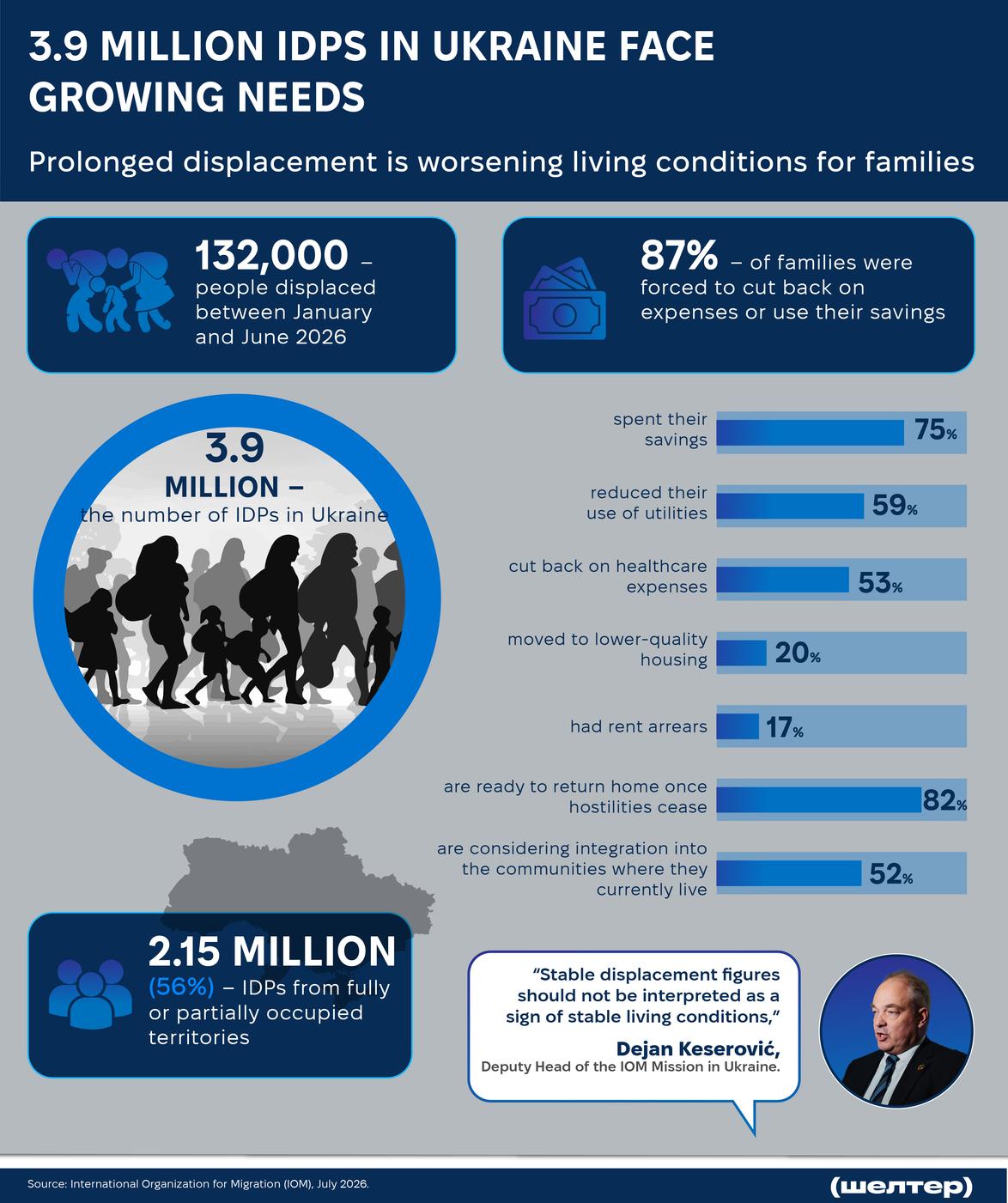
Approximately 2.15 million people, or 56% of all IDPs in Ukraine, come from areas that were fully or partially occupied at the time of the survey. They are more likely to face protracted displacement, greater hardships, and more limited opportunities for return.
The IOM emphasizes that emergency assistance alone is not enough. Displaced people need long-term support in the areas of housing, livelihoods, access to healthcare, protection, and other basic services.
The report is based on a survey of the Ukrainian population conducted by IOM from April 23 to June 30, 2026, with support from the Humanitarian Fund for Ukraine, the European Union, and the governments of Canada and Sweden.
Author

Iryna Mazipchuk managing editor
All materialsShe studied at the School of Journalism at Ivan Franko National University of Lviv. She has been working in journalism since 2011. She has worked for the television channels Channel 5, PravdaTUT, STB and ZIK.