“Methamphetamine has proven to be a very effective combat drug.” An interview with German writer Norman Oler
/88x88/filters:format(webp)/p/6/64/5c934dcce0bb5fc6d560a882c0030646.webp)
journalist
/2368x/filters:format(webp)/p/c/4b/ce0f9e73ec16e6860cf171069427b4bc.webp)
Hitler regularly received injections of opioids and stimulants from his personal physician. Wehrmacht soldiers took methamphetamine so they could advance into France without sleep or rest.
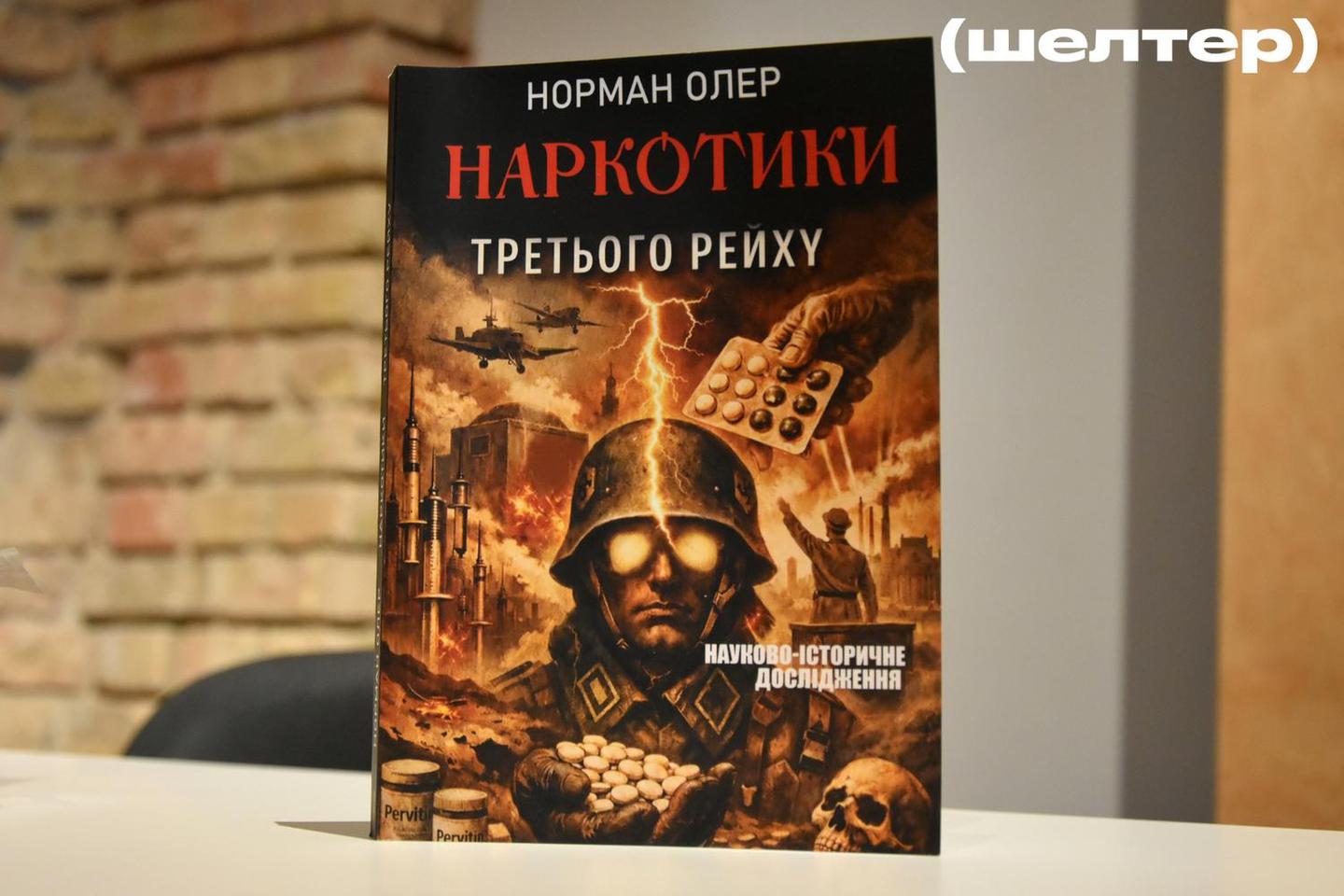
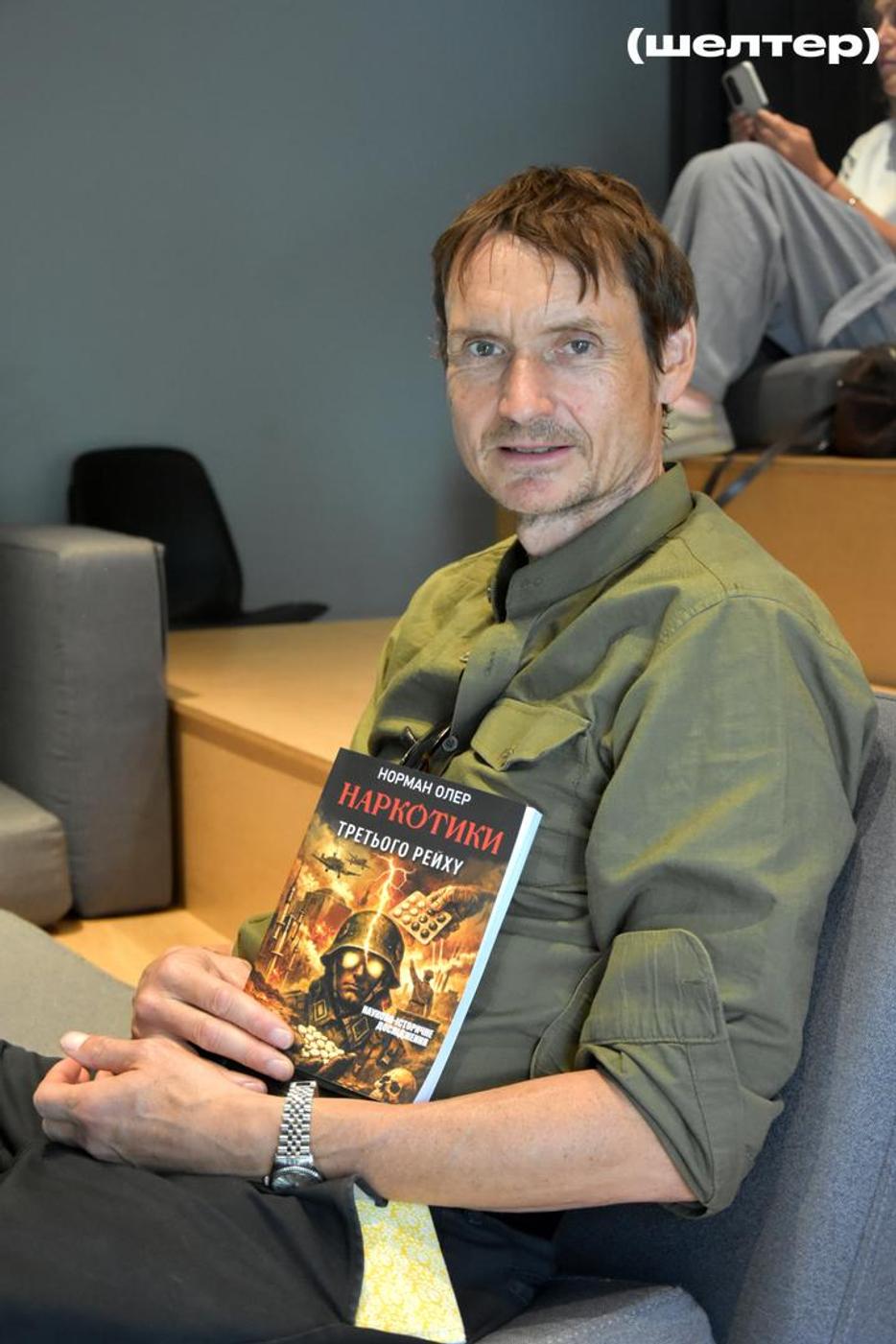
German writer Norman Oler was the first to investigate how psychoactive substances became part of the Nazi system. “We historians have overlooked this topic because we don’t use drugs,” one of the author’s mentors explained, noting why his colleagues had ignored it for decades. Norman Oler’s book *Drugs of the Third Reich* has been translated into more than 30 languages and was recently published in Ukrainian. The author came to Ukraine not only to present this book but also to gather material for a new one—about the role of psychoactive substances in human history. “Shelter” spoke with him about drugs and war.
– Your book *Drugs of the Third Reich* is about how the Nazis used psychoactive substances during World War II. How did you come across this topic in the first place?
– A friend of mine accidentally found some methamphetamine pills in an old pharmacy cabinet in Berlin. The pills had been sitting there since the Third Reich; they were about 60 years old. He tried them, and it turned out they were still pretty potent. So he told me that the Germans used methamphetamines. I didn’t believe him. But then I started researching the archives and realized that was exactly what had happened.
– And that’s when you realized this could become a book?
– I’ve always been interested in German history and the history of fascism. I wanted to understand how Germany got to that point. Besides, I was interested in drugs. This combination of Nazism and drugs was fascinating to me.
– What surprised you during your research for this book?
– Obviously, Hitler was a terrible person—and that’s the image of him that has taken root in Germany. But no one had pointed out that he was also a drug addict who used opioids—and did so regularly. The official ideology of Nazism preached freedom from drugs. And it was interesting to learn that drugs were, in fact, an important part of the Nazi system.
– But what does this addiction say about Hitler? Do you think it somehow absolves him of responsibility for his actions?
– In my opinion, no. I don’t want to say that he had a positive attitude toward drugs or that they were what turned him into a monster. His racist and fascist views had formed much earlier. He became addicted to drugs only toward the end of his life.
Historians have noted that after 1942–1943, he increasingly lost touch with reality. He made some very strange decisions. And no historian has been able to pinpoint the reason why this happened. But if you look at what he was using and in what quantities, it becomes clear why he was increasingly retreating into a fantasy world. This was especially true with opioids, as they seem to cut you off from the real world and strip you of any empathy for other people. This doesn’t excuse him, but I think it better explains how he became a completely emotionless monster who continued to kill without any rational reason, since these killings made no sense even for Germany’s victory in the war. I think this provides a clearer picture of Hitler, without downplaying his personal responsibility for all the crimes.
– You mentioned that your relatives were indirectly involved in Nazi crimes. How did that affect you?
– Well, my grandparents weren’t part of the resistance. But I believe that every German who was part of the system bears some responsibility for the genocide. Perhaps the one most involved in the Holocaust was my maternal grandfather, because he worked for the railroad. He saw trains carrying Jews heading east. He wasn’t an active participant in the crime; he merely ensured that everything in Germany functioned as needed to carry out the genocide. Genocide is committed by an entire society, not by any one individual.
My other grandfather served in the German army when it attacked the Soviet Union and took part in the occupation of Ukraine, which I deeply regret. During this trip through Ukraine, I tried to imagine where he had been and what he had done here. It is known that he was wounded here and nearly lost his leg after being run over by a Soviet tank. And he had to be sent home.
As a teenager, this troubled me. I thought I had to do something to prevent the return of fascism. That’s why I eventually became a writer—in the hope that my books would prevent the return of fascism to Germany.
– The second major theme of the book is the Wehrmacht soldiers’ use of methamphetamine. How did that work?
– The German army was the first to use synthetic drugs to enhance combat capabilities. Without judging whether this was good or bad, it was interesting to see how this program worked. They used “Pervitin” pills—methamphetamine had been produced under that brand name in Germany since 1938. At first, it could be bought at any pharmacy without a prescription. It was marketed as a performance enhancer. Methamphetamine proved to be a highly effective combat drug. In fact, armies around the world still use it today, including in the current Russia-Ukraine war. The Germans set a bad example of how to use harmful drugs to turn people who don’t want to kill into fighting machines. And as soldiers were transformed into killing machines, war crimes became more frequent.
– Do you believe that methamphetamine really helped the German army win battles during World War II?
– War is always a complex phenomenon influenced by many factors. But based on my research, I would say that the Blitzkrieg—the lightning war Germany launched against the West—would have been impossible without methamphetamine. In May 1940, German soldiers were issued 35 million doses of “Pervitin.” This allowed them to march nonstop through the Ardennes and reach France in three days. Methamphetamine is a psychostimulant that eliminates fatigue. Imagine you’re going to a club to dance for three nights in a row. It’s impossible to go three nights without sleep; you’ll want to go home and sleep. But if you’re on methamphetamine, you can keep going nonstop. “Pervitin” helped the Germans advance without rest and, as a result, quickly defeat France. So, I think the war on the Western Front was heavily influenced by methamphetamine.
In the war against the Soviet Union, the Germans also used methamphetamine and nearly succeeded. In the first three months, they conquered a vast territory—including the occupation of Ukraine—and came close to Moscow. Thanks to methamphetamine, they didn’t have to stop. But that can only last a few weeks; then depression and fatigue set in. In reality, methamphetamine doesn’t actually give you more strength. It provides more energy in the short term, but it wears you out in the long term. And since the Germans were unable to capture Moscow after three months—because winter had set in—the war against the Soviet Union became a protracted one. And in that situation, methamphetamine actually does more harm than good, because people become addicted to it.
– Were the Germans aware of these risks at the time?
– The professor in charge of this program based it on research conducted by German universities. They had just begun researching methamphetamine and initially focused on the positive effects—reduced fear, decreased need for sleep, and suppressed appetite—which were beneficial for the army. This professor was overly optimistic; he considered methamphetamine a miracle drug.
It was only after the victory over France that the first negative reports from soldiers began to surface; they said they were completely exhausted and had to sleep for long periods to compensate for the energy they had expended. Two officers died of heart attacks due to methamphetamine overdoses. Thus, critical feedback began to emerge in the summer of 1940, and the risks became increasingly well-known. Germany’s Minister of Health tried to put a stop to it, but the army was opposed. After their success in France, they didn’t want to stop. Moreover, Germany had always waged asymmetric warfare. It was much smaller than all the enemies it had attacked, so it had to resort to extreme measures, one of which was methamphetamine.
– Did the armies of the anti-Hitler coalition use anything similar?
– I wasn’t able to access the archives in Moscow because they’re closed. But I haven’t found any traces or reports indicating that the Red Army used methamphetamine. I’m sure the Russians would have used it if they’d understood it. But I don’t think they knew about it in Moscow. Methamphetamine was very new; production began in 1938, and by 1939 it had already made its way onto the battlefield.
– What about other stimulants, such as cocaine?
– Cocaine was used in World War I, but it’s very expensive. The Red Army wouldn’t have been able to use it on a large scale. Soviet soldiers obviously drank vodka, which is cheap. It’s not really a very good drug for combat. Although, perhaps it’s better than nothing. The French used red wine, just as they did in World War I. As for the British: they conducted experiments and later began using amphetamine—it’s like methamphetamine’s cousin, but not as potent. The Americans also used amphetamine. But I don’t think the Russians did. Although there’s evidence that they’re doing it now. Other military groups are also using these drugs right now.
– What do you know about the current situation in the world’s militaries? Who is doing this, and what exactly are they using?
– Elite American soldiers approached me and told me that their commanders and medical officers give them everything that’s legal in the U.S. They can’t use, say, cocaine, because it’s banned. But many amphetamines are actually legal in the U.S., such as Adderall (a medication used to treat attention-deficit/hyperactivity disorder and narcolepsy—Ed.). There are some legal opioids and even methamphetamines on the market in the U.S.
– You mentioned that Hamas terrorists also used stimulants during the attack on Israel in October 2023, correct?
– That’s what my research showed. They likely used “Captagon,” which is somewhat similar to methamphetamine.
– Does using it cause people to act with particular cruelty?
– I think so. People are generally pretty decent by nature. It’s hard for them to kill someone, but under the influence of “Captagon” or methamphetamine, it becomes easier. It has been proven that stimulants inhibit self-control and intensify aggressive behavior. If I were a Ukrainian soldier, I think it would be very tempting to use something like that, because it gives you a rush of energy.
– You’ve researched World War II. And now you’ve come to Ukraine to investigate what’s happening here. Do you see any historical parallels between these wars?
– World War II was Germany’s attempt to colonize other nations, to make them all German. All of Europe was supposed to become Germany; in particular, Ukraine was supposed to become Germany, and there were supposed to be German villages everywhere here. Such colonial policies were carried out all over the world for a long time: the British Empire, the Russian Empire—even in Africa, there were tribes that colonized others. This is very crude and violent behavior.
Now Russia is trying to colonize Ukraine, claiming that Ukraine, in fact, has no identity of its own and must be part of the Russian state. It’s a bit like when Germany told Austria that it should be part of Germany. And quite a few Austrians supported that idea back then. But Ukrainians don’t want to be part of Russia—at least, I haven’t met a single Ukrainian who wants that.
So yes, I see parallels. I also think that Putin is an example of a fascist leader, just like Hitler.
– Do you think he has drug problems too, like Hitler did?
– I’m almost certain that Putin, as a biohacker, uses peptides and takes cold showers in the morning, and then tries to optimize his health so he can live forever and build a great Russian empire. Hitler did the same thing; he, too, tried to defeat death. To do so, he took opioids, steroids, and all sorts of other crap, thinking it was good for him. But in fact, it only ruined his health. Which is quite ironic. I don’t know if Putin will meet the same fate. But he seems to have better advisors than Hitler did. Unfortunately. Hitler had only one crazy doctor.
– Your second nonfiction book, *Tripped* (there’s no Ukrainian translation of the book), is about another class of substances—psychedelics. What did you learn about the experiments conducted by various intelligence agencies with these substances?
– The Nazis were interested in whether a “truth serum” existed that could be used during interrogations to extract secrets from someone. They conducted experiments with psychedelics at the Dachau concentration camp, but these experiments didn’t lead to anything. When the Americans liberated Dachau, they found these SS reports and decided to continue the work.
The Americans were curious about exactly which substances the Nazis had used in their experiments. They suspected it was LSD. While working on this book, I found evidence suggesting that this was likely the case. At that time, LSD was a new substance; its psychoactive properties were discovered in 1943 at the Swiss pharmaceutical company Sandoz. The CEO of Sandoz was friends with the leading Nazi biochemist Richard Kuhn, who was responsible for developing the “truth serum.” In 1943, the Swiss scientist sent LSD to the German, who then used the substance in the camp.
Later, the Americans learned about LSD and began using it themselves. The corresponding CIA program was called MKUltra. In essence, the Americans continued the SS’s experiments.
– At the same time, in the 1950s and 1960s, scientists were conducting other studies on psychedelics. Back then, they were considered very promising treatments for mental health. Now there’s talk around the world of a psychedelic renaissance. Several countries have authorized the limited use of psychedelics to treat depression and PTSD. Why do you think, at the dawn of this research, things went so wrong—why were all these substances banned and equated with hard drugs?
– I think the CIA wanted to keep LSD as its own weapon, rather than as a medicine for the benefit of public health. But it’s also fair to say that lobbying by big pharmaceutical companies prevented psychedelics from reaching the market.
– What about the counterculture movement in the U.S. in the ’60s? The protests against the Vietnam War and for African American rights were deeply intertwined with psychedelics. One of President Nixon’s advisors said, “We knew we couldn’t ban being against the war or being Black,” so they simply decided to ban these substances.
– Yes, the peace movement also played a role. On the other hand, we might not even know about psychedelics today if the CIA hadn’t made them so popular. It was the CIA that gave it to people like Ken Kesey, who then popularized it (in 1959, author Ken Kesey was a test subject in one of the experiments of the CIA-funded MKUltra program, during which he first tried LSD; later, he hosted psychedelic parties at his home—Ed.). John Lennon once said that we should thank the CIA and the military for giving us LSD. Perhaps psychedelics would have spread even without the CIA. Or perhaps they would simply have become medications that psychologists would prescribe to their patients in specific doses. And that crazy LSD cult—where millions of people took it and then started dancing—might never have emerged. But we don’t know for sure how things would have turned out.
– There was also a personal story behind your book on psychedelics. Its working title was “LSD for Mom.” Can you tell us more about that?
– My mom has Alzheimer’s disease. One day I read a scientific article stating that LSD in low doses could help treat this disease. I told my father about it. He then asked me to investigate why LSD was banned. And I wrote this book to show him that LSD wasn’t banned because it’s harmful to us, but because it’s harmful to the government.
Then we had my mom try psychedelics. She felt better. When she tried psilocybin mushrooms (in a microdose that doesn’t induce a trip but merely stimulates the brain), she picked up a newspaper for the first time in a year and was able to read the headline. The headline was about the war in Ukraine. This was about a year after the full-scale invasion began. Since she had been suffering from dementia lately, she hadn’t heard about the war. She couldn’t pronounce the word “Ukraine” correctly. But it was still progress.
– How is she doing now?
– She’s worse off again because my father stopped giving her LSD. She’s in a nursing home now. He says he doesn’t want to break their rules because psychedelics are still illegal. But I think he’s wrong.
– But there have been some developments in Germany regarding psychedelics; they’ve allowed the limited use of psilocybin for treatment-resistant depression. Is German society now more willing to accept that psychedelics can be medicine?
– It’s not a widely discussed topic in Germany. People actually know very little about it. Yes, a slow shift is taking place, just as it is in every Western country. The more people understand, the more news stories appear. But the government is still uninformed on this issue; it doesn’t accept it. Personally, though, I believe in the potential of psychedelics for mental health.
– You’ve written one book about substances that helped wage wars, and another about other drugs that can help people recover from them. What’s your next book about?
– It’s a book that explores the role of drugs in the history of our civilization. It’s called *Stoned Sapiens* (literal translation: “Stoned Sapiens”—Ed.). It’s scheduled to be published in Ukraine in late 2027.
– Were you able to learn anything about drug use in Ukraine’s ancient history?
– Yes, a little. I visited the village of Legedzyne, at an archaeological excavation site. There, they found evidence of drug use that may have played a role in the Trypillian culture.
– What specific drugs are we talking about?
– It’s not known for sure; archaeologists found something resembling small cups, but there were no traces of the substances themselves.
– What else did you research during your travels through Ukraine?
– The Ukrainian army is the first army in the world to use a specific psychedelic compound to improve combat performance and provide a better understanding of what’s happening on the front lines. I’m not sure if I should mention the name of this compound. But I came here, in part, to learn more about it. I think it’s a very innovative approach. But I’ll also note that the Ukrainian army doesn’t use it at the official level.
I can say that many people in the Ukrainian army know a great deal about psychedelics and psychedelic-assisted therapy (a method of psychotherapy involving the use of psychedelic substances—Ed.). Although it is still not permitted in Ukraine. But I’m confident that it’s a very effective method for veterans (studies show that MDMA is effective against PTSD, and psilocybin against depression—Ed.). I think Ukraine should use it more often.
Author

Olena Panchenko journalist
All materialsShe studied at Taras Shevchenko National University of Luhansk. She has been a journalist since 2010. She has worked for the publications "RBC-Ukraine," "Apostrophe," and "Village."